“International trade consulting” is a broad label, and firms
that use it don't all offer the same thing. At a functional
level, international trade consulting services typically span
five areas:
-
Foreign Direct Investment (FDI) facilitation:
structuring inbound or outbound investment, navigating
approval routes, and identifying incentive schemes.
-
Market entry strategy:
evaluating entry modes such as joint ventures, wholly owned
subsidiaries and distributor agreements, sizing demand,
and mapping regulatory requirements.
-
Trade missions and delegation support:
connecting businesses with government-led trade programmes
and on-ground buyer or partner networks.
-
Procurement and supply chain advisory:
sourcing strategy, supplier diversification, and risk
management across trade corridors.
-
Mergers and acquisitions (M&A):
cross-border deal structuring, due diligence, and
post-merger integration.
A firm that only offers one of these, say market research without
any regulatory or deal-structuring capability, isn't really
providing “international trade consulting” in the full sense of
the term; it's providing a narrower service under a broader label.
Worth clarifying scope early.
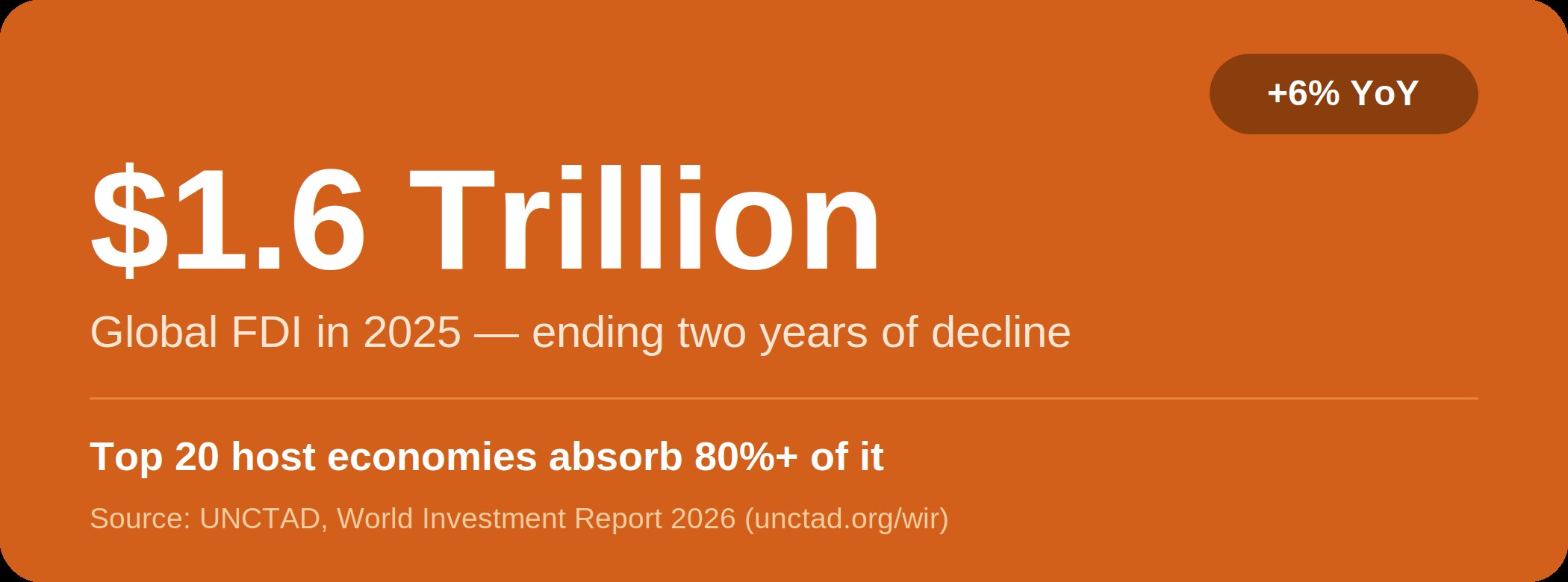
According to
UNCTAD's World Investment Report 2026
,
global foreign direct investment rose 6% to $1.6 trillion in
2025, ending two years of decline, but the recovery is narrow
and uneven, with the world's top 20 host economies now absorbing
more than 80% of global FDI.
Investment is also concentrating heavily in a small number of
strategic sectors, while government screening and industrial
policy measures are playing a larger role in shaping where
capital is welcome.
In practice, that means the regulatory and competitive landscape
a company plans against today can look different within a single
fiscal year.
This is the environment international trade consulting firms are
built for: tracking policy shifts, screening rules, and
sector-specific incentives across multiple jurisdictions at once,
something an internal team focused on one home market usually
isn't resourced to do.
India's investment and trade rules carry their own specific
complexity: FEMA regulations, DPIIT approval routes, sector-wise
FDI caps, and state-level incentive schemes that vary widely by
industry.
If you're looking for a foreign trade consultant in India, or an
international trade consultant India-based companies can rely on
for outbound expansion, a few things are worth checking before
you commit:
-
Regulatory depth, not just familiarity:
ask for examples of recent approvals or filings the firm has
handled in your sector, not general knowledge of FEMA or DPIIT.
-
Two-way capability:
many firms only support one direction, India-inbound or
India-outbound; stronger partners do both, since the
operational playbook overlaps significantly.
-
Sector-specific precedent:
defence, manufacturing, and technology each carry different
approval pathways and screening sensitivities.
-
On-ground presence, not just advisory:
firms with an actual local network deliver differently than
firms offering research-only support from a distance.
Not every engagement needs a global firm. But when a company is
entering multiple markets, structuring a cross-border deal, or
managing a multi-country supply chain, the gap between global
trade consulting capability and a local-only advisor becomes
significant.
|
Capability
|
Global Trade Consulting Firm
|
Local-Only Advisor
|
|
Multi-country regulatory coverage
|
Tracks FDI, trade, and screening rules across
several jurisdictions simultaneously.
|
Typically deep in one market, with limited
visibility elsewhere.
|
|
Sector benchmarking
|
Can compare incentive structures and entry
conditions across countries.
|
Limited to local sector knowledge.
|
|
Trade mission and delegation access
|
Often connected to government-led trade
programmes and buyer networks abroad.
|
Rarely has cross-border delegation access.
|
|
M&A and procurement integration
|
Can combine deal structuring with sourcing and
supply chain strategy.
|
Usually offers one service in isolation.
|
|
Post-entry support
|
Provides ongoing compliance and operational
support after entry.
|
Often ends at the advisory or filing stage.
|
Neither model is automatically better. A company entering a
single, familiar market with straightforward compliance needs
may not need global reach.
But a company planning entry into two or three markets, or
structuring a cross-border transaction, generally gets more
value from a firm built for that scope.
A few patterns worth being cautious about when evaluating
international trade consulting firms:
-
Vague scoping —
if a firm can't clearly define what's included in
“market entry strategy” or “FDI facilitation” for your
specific case, the engagement is likely to expand in cost
later.
-
No sector-specific case studies —
general success stories without sector detail suggest a
generic playbook.
-
One-sided geographic strength —
strong on India-inbound but no outbound track record
or vice versa may not fit needs that run both directions.
-
No post-entry support —
firms that disengage once paperwork is filed leave clients
without support exactly when operational issues tend to
surface.
-
No named regulatory contacts or precedent —
established firms can usually point to specific approval
routes or government bodies they've worked with directly.
Crescendo Worldwide works across 150+ countries, supporting both
inbound and outbound trade and investment, from FDI facilitation
and market entry strategy to procurement, supply chain advisory,
and cross-border M&A.
For companies evaluating a foreign trade consultant in India
specifically, that means one partner who can handle India-side
regulatory work alongside the global market entry, sourcing, or
deal-structuring components of the same expansion plan, rather
than coordinating multiple disconnected vendors.
Explore our
FDI facilitation services
,
M&A advisory
,
procurement and supply chain consulting
,
or
global business services
to see how these capabilities come together for cross-border
expansion.
Ready to talk through your expansion plans?
Get in touch with Crescendo Worldwide
.